
October 27, 2026 · 5 min read
Double glazing: how the U-value and SHGC change with each upgrade
What is inside a double-glazed unit and how much each step adds: the cavity, its width, the low-E coating, argon and triple glazing, with the numbers.
Saying "double glazing" is like saying "engine": it tells you very little until you know what is inside. Two units that look identical can differ twofold in how well they insulate. Here, step by step, is what each decision changes and by how much.
What is inside a unit
A double-glazed unit, or IGU, is two panes separated by a sealed cavity. What keeps that cavity in place, dry and airtight, sits at the edge:
Section through the edge of a double-glazed unit
- 1Outer pane
- 2Inner pane
- 3Cavity: air or argon
- 4Spacer with desiccant
- 5Primary seal (butyl)
- 6Secondary seal (silicone or polysulphide)
When a unit fogs up on the inside, the seal has failed: moisture got in and saturated the desiccant. It cannot be cleaned; the unit has to be replaced.
The three numbers that matter
- Ug is the glass U-value: how many watts cross a square metre for each degree of difference between inside and out. It measures insulation. Lower is better.
- g, the solar factor, is what fraction of the sun's energy ends up inside. US data sheets call it SHGC; it measures the same thing with a different calculation method. Lower means less solar heat.
- LT is the percentage of visible light that gets through. Higher means more daylight.
Ug rules whenever there is a temperature difference between inside and out, at any hour. g rules when the sun is on the glass. In Monterrey both matter, and on a west façade at five in the afternoon, g usually matters more.
The U-value, step by step
We start with a single 6 mm clear pane and make one improvement at a time. Every value comes from the same EN 673 calculation:
Ug by build-up · W/m²K
Show the values as a table
| Build-up | Ug |
|---|---|
| Single pane 6 mm · One clear pane | 5.68 |
| Double 6 / 12 air / 6 · Two clear panes, air cavity | 2.91 |
| Double 6 / 16 air / 4 · Wider cavity | 2.82 |
| Low-E · 12 air · ε 0.03 coating on face 2 | 1.59 |
| Low-E · 16 air · ε 0.03 coating, 16 mm cavity | 1.34 |
| Low-E · 16 argon · Argon-filled cavity | 1.06 |
| Triple · two low-E · argon · 4 / 12 Ar / 4 / 12 Ar / 4 | 0.70 |
What the chart says:
Glass thickness barely insulates. Glass conducts heat well. A 6 + 6 laminate, with twice the glass, only takes Ug from 5.68 to 5.43. The cavity is what insulates.
The first cavity halves the loss. From 5.68 to 2.91 W/m²K with two clear panes and 12 mm of air.
The low-E coating is the biggest single jump. In a cavity between two clear panes, two-thirds to three-quarters of the heat crosses as radiation from one pane to the other. A low-emissivity coating cuts almost all of that. That is why, with the same 16 mm cavity, Ug falls from 2.82 to 1.34.
Argon finishes the job. It conducts 33 % less than air, taking the same unit from 1.34 to 1.06.
Triple glazing reaches 0.70, but it is heavier, 36 mm thick and does not fit every profile. More on that below.
Cavity width has an optimum
A wider cavity is not always better. As it opens up, the gas insulates more, until it starts to circulate by convection: rising on the warm side, falling on the cold one and carrying heat with it. Past that point, widening no longer helps.
Ug by cavity width · W/m²K
- Clear · air
- Low-E · air
- Low-E · argon
Show the values as a table
| mm | Clear · air | Low-E · air | Low-E · argon |
|---|---|---|---|
| 6 | 3.33 | 2.43 | 1.93 |
| 8 | 3.14 | 2.06 | 1.61 |
| 10 | 3.02 | 1.79 | 1.38 |
| 12 | 2.93 | 1.59 | 1.22 |
| 14 | 2.86 | 1.44 | 1.09 |
| 16 | 2.82 | 1.34 | 1.06 |
| 18 | 2.83 | 1.36 | 1.07 |
| 20 | 2.83 | 1.37 | 1.09 |
| 24 | 2.84 | 1.39 | 1.11 |
With air or argon and a low-E coating, the minimum lands around 16 mm. That is why 6 / 16 / 4 and 4 / 16 / 4 are such common build-ups.
And the SHGC: the coating is in charge
The cavity changes the U-value a lot but the solar factor very little. What moves it is the coating. A 6 mm clear pane lets in about 82 % of the solar energy; a double-glazed unit with a selective coating such as Saint-Gobain's Cool-Lite SKN 154 lets in 27 %, and still passes half the light.
The full comparison between coatings, with their light, solar factor and selectivity, is in low-E glass: how low emissivity works.
Thickness matters when choosing the profile
The unit has to fit the profile. In the Extrusiones Metálicas thermal-break series we fabricate:
| Series | Maximum glazing | What fits |
|---|---|---|
| 2400 RPT sliding | 24 mm | 4 / 16 / 4 or 6 / 12 / 6 |
| 2500 RPT casement | 24 to 30 mm | Up to 6 / 16 / 6 or 6 / 18 / 6 |
A 36 mm triple unit fits neither. So in these series, the upgrade that pays most is a 16 mm double unit with a low-E coating and argon.
And the glass is only part of the window: the profile counts too. We combine them in the estimator in the Extrusiones Metálicas RPT series.
What to ask for
| Situation | Look at first |
|---|---|
| West or south façade in direct sun | Low g: selective coating on face 2 |
| Space air-conditioned all day | Low Ug: low-E coating and argon |
| Window where the view is the point | High LT with low reflection: selectivity above 2 |
| Bedroom facing a busy road | Asymmetric build-up with one laminated pane |
How we approach it
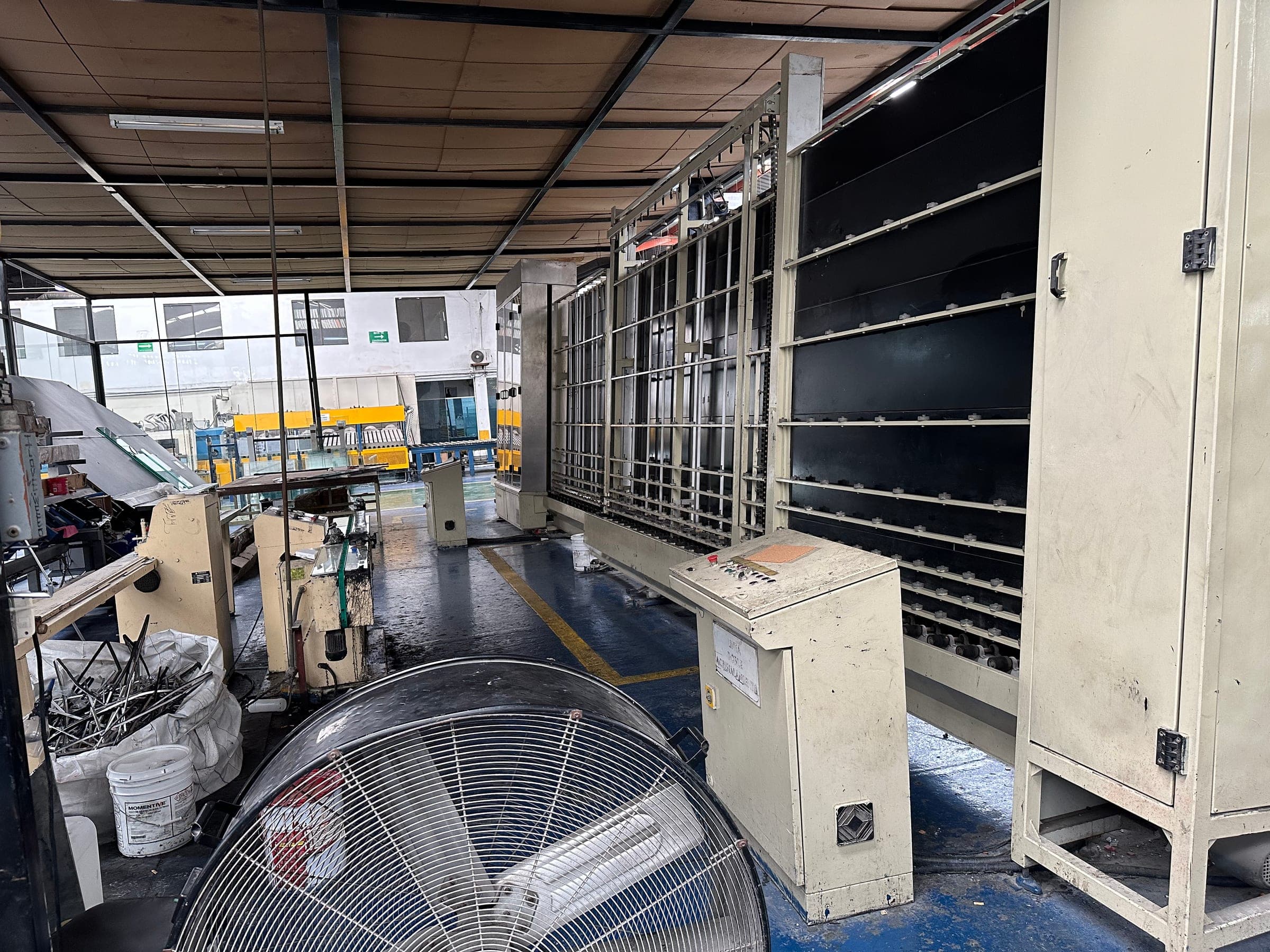
We assemble double-glazed units on the insulating line at our plant, with a dual perimeter seal and a desiccant spacer. Send us your openings with their orientation and we will propose a build-up for each, with its Ug and solar factor.
Sources
- Ug values: VECA calculation to EN 673, vertical glazing, ΔT 15 K, 100 % argon where stated. It agrees with two published references: Saint-Gobain gives Ug 1.0 for SKN in 6 / 16 / 4 with 90 % argon, and Extrusiones Metálicas tests its RPT series with a 4 / 16 / 4 Planitherm unit at Ug 1.4.
- Saint-Gobain, Glass for Façade 2018: LT and g of Cool-Lite SKN 154 in double glazing.
- Extrusiones Metálicas, 2400 RPT and 2500 RPT catalogues (2022): maximum glazing thickness.