
October 6, 2026 · 5 min read
Thermal break: what it is and what it changes in an aluminium window
Why an aluminium profile lets so much heat through, how a polyamide bar stops it, and when a thermal break is worth specifying in Monterrey.
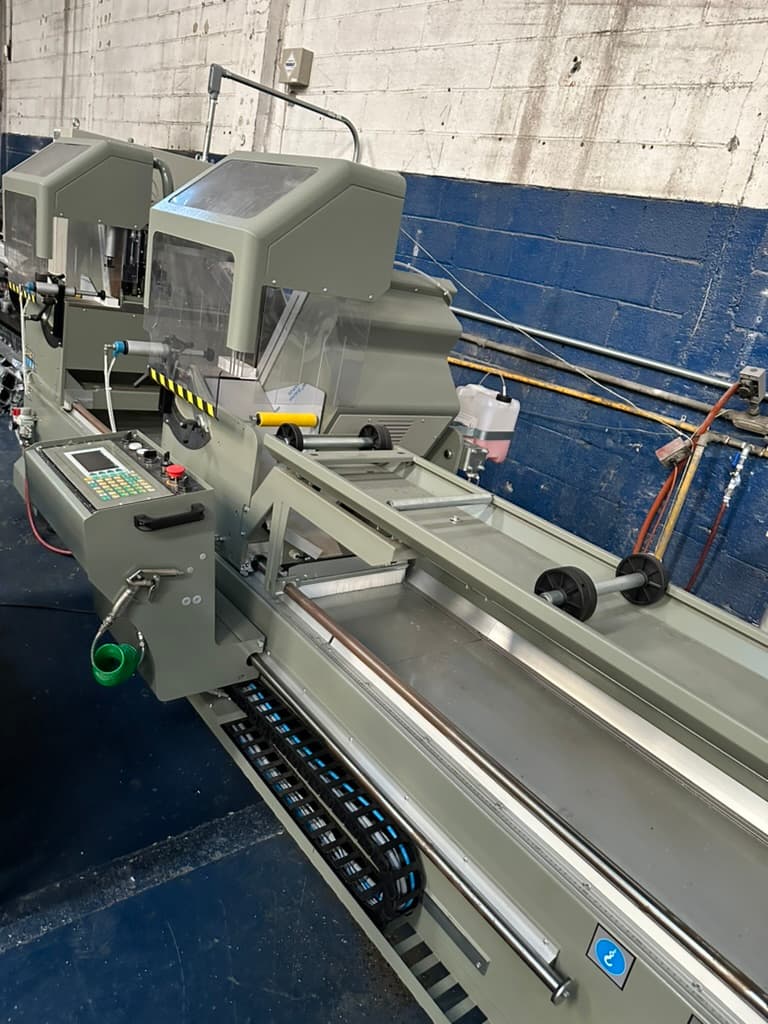
Aluminium has everything a window asks for: it is light, stiff, does not rust and can be extruded into almost any shape. It has one flaw, and it is a serious one: it conducts heat exceptionally well. A thermal break, known in Mexico as RPT (rotura de puente térmico), keeps everything good about aluminium and removes that flaw.
The problem: aluminium is a conductor
The thermal conductivity of an aluminium alloy for window profiles is around 160 W/m·K. The glass-fibre-reinforced polyamide used in thermal-break bars is around 0.3 W/m·K. That is roughly five hundred times less.
A conventional profile is a single piece of metal running from the outside face to the inside one. On a summer afternoon in Monterrey, with the west façade in full sun and the street above 35 °C, that metal is a direct path: heat comes in through the frame even when the glass is good, and the inner face of the profile ends up warm to the touch. In winter the reverse happens; on cold mornings the frame chills enough for indoor moisture to condense on it.
That is a thermal bridge: a point in the building envelope where heat finds a shortcut.
The fix: cut the path
A thermal-break profile is made as two aluminium half-shells, one outside and one inside, joined by polyamide bars that are inserted and crimped into channels in the profile itself. The metal is no longer continuous: to get from one side to the other, heat has to cross the polyamide.
Schematic profile section
- Aluminium
- ≈ 160 W/m·K
- Polyamide
- ≈ 0.3 W/m·K
The profile still works structurally as one piece, because the joint is mechanical. Thermally, though, it is two.
What it looks like in a real calculation
Extrusiones Metálicas publishes the thermal simulation of its RPT series, run to EN ISO 10077-2. The image shows the 2400 series section with 0 °C outside and 20 °C inside. Look at where the colour changes: the outer half of the profile stays blue, the inner half turns green and yellow, and the transition happens right at the polyamide bars.
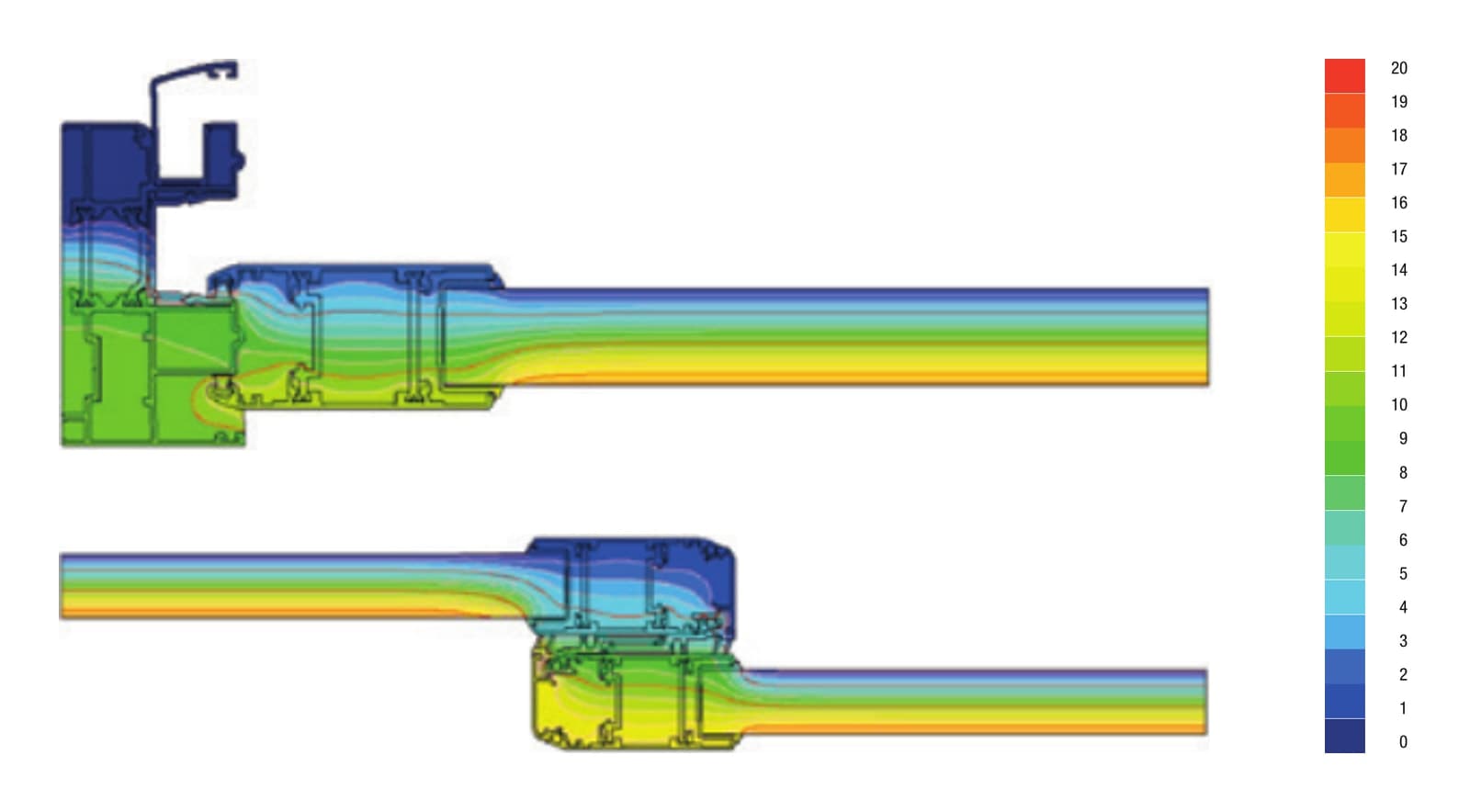
That Uf value is the profile's thermal transmittance: how many watts cross a square metre of frame for each degree of difference between inside and out. Lower is better.
More polyamide, better insulation
Not all thermal breaks are equal. The wider the polyamide bar, the longer the path the heat has to travel. The reference tables in Scotland's building standards, which give indicative window values based on EN ISO 10077-1, put numbers on it: starting from a 4 mm break, a 12 to 16 mm break lowers the U-value of the whole window by 0.2 W/m²K, a 20 mm break by 0.3 and a 32 mm break by 0.4.
In the Extrusiones Metálicas Línea Española range the bars run from 14.8 to 32 mm depending on the series and the section. The 2400 series combines 18, 28 and 32 mm bars across its frames and sash; the 2500 uses 24 mm in every section.
What a thermal break does not do on its own
The frame is only part of the window: the same Scottish tables assume it covers 20 to 30 % of the area. The rest is glass, and that is where most of the loss happens.
That is why a thermal-break window with single glazing is money badly spent. The manufacturer's own catalogue says it plainly: the system is designed for double glazing with a cavity, which is where the best thermal performance comes from. Thermal break and double glazing are specified together or not at all.
We go into that in detail in double glazing, U-value and SHGC.
What it brings for free
- Less condensation. The inner face of the frame stays close to room temperature, so moisture no longer finds a cold surface.
- Two-tone profiles. Because the two half-shells are separate pieces, each can take its own finish: black outside for the façade and white inside, for example.
- Less load on the air conditioning. In a climate like Monterrey's, which needs cooling for most of the year, every bit of heat that does not come in through the frame is heat the system does not have to remove.
When to specify it
It pays off in any space that is air-conditioned for most of the day: bedrooms, living rooms, offices. It matters most on west and south façades, and on large openings, where the run of frame is long.
It makes less sense in unconditioned spaces such as storerooms and garages, or where the glazing is going to be single anyway.
To see how the four RPT series we fabricate compare, read the Extrusiones Metálicas RPT series.
How we do it at VECA
We cut, machine and assemble the thermal-break profiles at our plant in Santa Catarina, and temper and insulate the glass under the same roof. If you have a project coming up, send us the list of openings with their orientation and we will recommend a series and glazing for each one.
Sources
- Extrusiones Metálicas, 2400 RPT sliding series and 2500 RPT casement series catalogues (2022): polyamide lengths, Uf and simulation to EN ISO 10077-2:2012.
- Scottish Government, Tables of U-values and thermal conductivity, tables 6.A.1 to 6.A.3: frame fraction and thermal-break width adjustments.