
November 17, 2026 · 7 min read
Soundproof windows: what actually works and what doesn't
How to keep street noise out with windows: acoustic laminated glass, asymmetric double glazing, casements versus sliders, and why one small gap undoes it all.
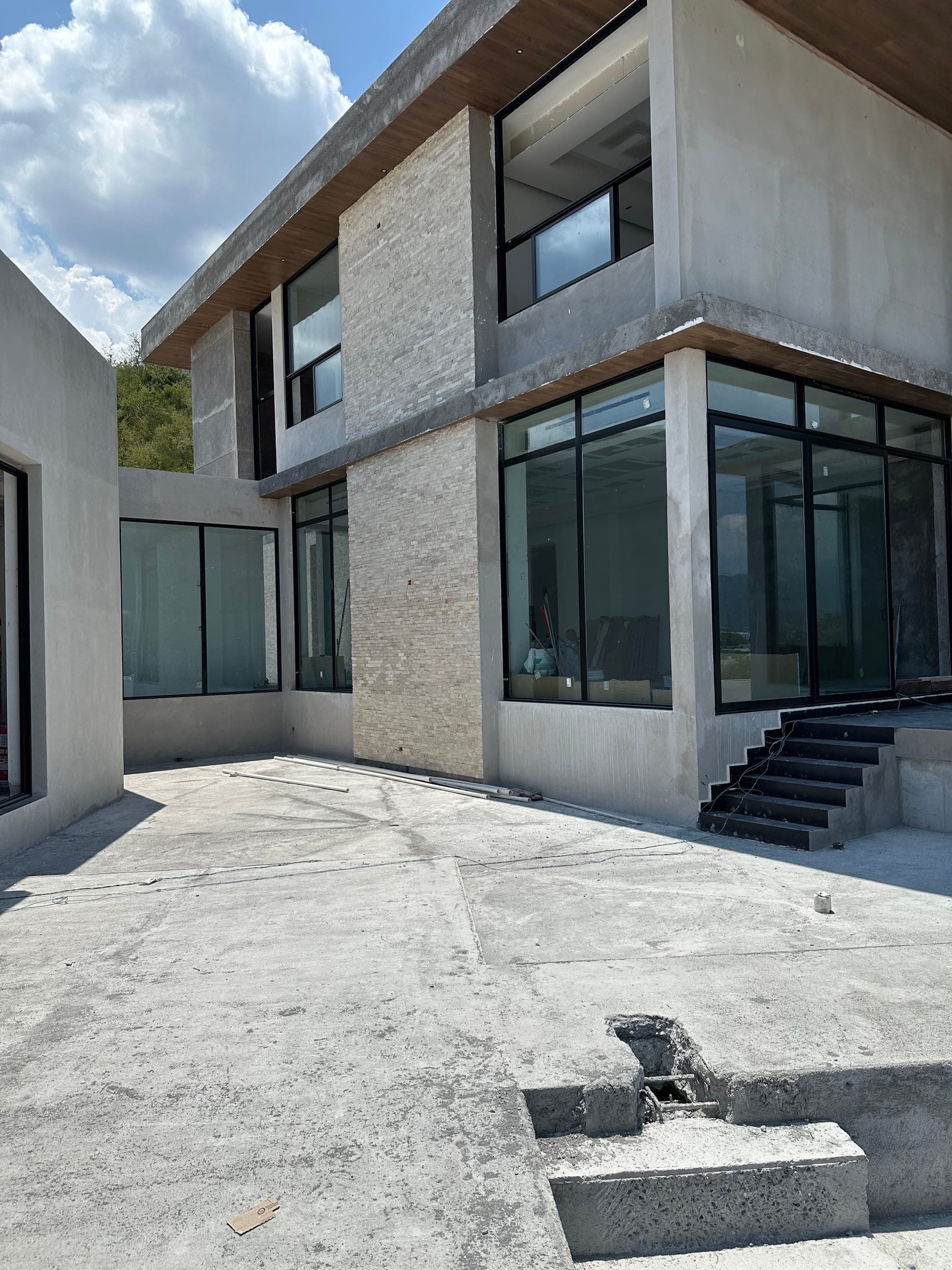
Anyone who lives on a busy road knows you never get used to the noise: trucks at five in the morning, motorbikes, horns. In Monterrey more and more apartments and houses sit next to major roads, and the question we hear most is whether "double-pane windows" will fix it.
Sometimes they do. Often they don't, and the glass is not to blame. This guide explains how noise gets through a window, what each decision changes, and where most of the insulation is lost.
First, decibels
Sound is measured in decibels (dB), and the scale is not linear:
- 10 dB less sounds like half as loud. 20 dB less sounds like a quarter.
- 3 dB is about the smallest change most people notice without a side-by-side comparison.
- A road with steady traffic runs at around 70–75 dB(A) at the facade.
- For good sleep, the World Health Organization recommends that a bedroom stay below about 30 dB(A) of continuous noise at night.
In other words, facing a busy road the window has to take out around 40 dB. An ordinary slider with single glazing takes out a lot less.
How a window's insulation is rated
Manufacturers publish sound insulation as an index called Rw, in decibels, measured in a laboratory to EN ISO 717-1. The higher it is, the better. In the US you will more often see STC (ASTM E413) and OITC (ASTM E1332). STC is roughly comparable to Rw; OITC is the traffic-noise rating.
Next to Rw there is almost always a negative adjustment, Ctr. It corrects the result for traffic noise, which carries a lot of low-frequency energy (the rumble of a truck engine), exactly where glass insulates worst. For a window facing the street, the number that matters is Rw + Ctr: a sheet that says Rw 38 (−1; −5) behaves like about 33 dB against traffic.
How noise gets in
Sound travels through the air and makes whatever it hits vibrate. Through a window it has three paths:
- Through the glass. It makes the pane vibrate, and the pane radiates the sound back out on the inside.
- Through gaps. Any air path is a sound path: a slider's weatherstrip, a gasket that isn't seated, a vent.
- Around the perimeter. The joint between the frame and the wall, if it was left hollow or poorly sealed.
The second path is the one hardly anyone thinks about, and the one that matters most. A window's insulation is worked out by adding up the energy passing through each part, and a gap lets through almost everything that reaches it. Try moving the gap:
How much noise gets in · glass versus gap
- Glass Rw
- 37 dB
- Assembly Rw
- 37 dB
- 0 dB
- lost to the gap
With Rw 37 acoustic laminated glass, a gap of 0.1 % of the window area (on a 1.5 × 1.5 m window that is about 22 cm², 3½ sq in: a 1.5 mm, 1/16" gap along one side) already drops the assembly to about 29 dB. At 1 %, the best glass on the market behaves like an old single pane. That is why glass alone does not solve noise: first, stop the air.
The glass: mass, asymmetry and lamination
Once the air is under control, the glass does make the difference. Three rules:
More mass insulates more. Thicker glass weighs more and vibrates less. Going from 6 to 10 mm gains a few decibels.
Symmetric double glazing barely helps against traffic. It sounds odd, but a 6/12/6 unit insulates about the same as a single 6 mm pane against street noise. The two identical panes and the air between them resonate together right in the low frequencies. Double glazing is excellent for heat; for noise it has to be designed.
Asymmetry and acoustic laminate do help. Two panes of different thickness (for example 8 and 4 mm) vibrate at different frequencies and don't reinforce each other. And acoustic laminated glass (two panes bonded by an acoustic PVB interlayer, softer than the standard one) damps the vibration instead of passing it on. Combining both, a double unit with one acoustic laminated pane, is the most effective option in an ordinary window.
| Glass | Typical Rw |
|---|---|
| Single 6 mm | 31 dB |
| Double 6/12/6 | 31 dB |
| Asymmetric double 8/12/4 | 34 dB |
| Acoustic laminated 44.2 | 37 dB |
| Double with acoustic laminate | 41 dB or more |
Typical catalog values, rounded. Each manufacturer publishes its own.
A bonus: laminated glass is also safety glass. If it breaks, the interlayer holds the pieces. More in tempered, laminated or insulated glass.
The frame and the opening type
This is the decision that matters most after the gaps.
Sliding. The sashes have to slide, so they seal with weatherstrip and always leave some air path. A good slider with double weatherstrip and a generous interlock can work on a quiet street. Facing a busy road it falls short, even with the best glass.
Casement, tilt-and-turn or awning. The sash closes against compression gaskets all the way round, with several locking points. The air path is almost nil and the glass can work to its full rating. This is the right opening for a bedroom facing the street.
Vinyl or aluminum. The material matters less than the opening type. European vinyl systems are usually very tight from the start, with chambers that help damp sound; good aluminum casement series reach similar results. What doesn't work is an economy slider in the hope that the glass will do all the work.
Lift-and-slide. For large terrace doors, a lift-and-slide (the sash lifts to slide and drops to seal against gaskets) insulates far better than a regular sliding door.
Installation: the path nobody sees
An excellent window badly installed insulates like a bad window. The joint between frame and wall has to be filled and sealed inside and out: polyurethane foam in the gap and an elastic sealant on both faces. A perimeter with voids is one more gap, just hidden behind the plaster.
Other common weak points: a roller-shutter box, vents in the window or the wall, and mini-split lines passing through the wall next to the window.
When it isn't enough: a double window
For extreme cases (a bedroom right next to a highway, a recording studio, a clinic facing a hospital), the answer is two independent windows in the same opening, 10 cm (4") or more apart. Each insulates on its own, and the air between them decouples them. It is the setup that reaches the highest figures, at the cost of price and wall depth.
Ventilating without opening
A tight window solves the noise, but it also shuts off the room's natural ventilation. In an air-conditioned bedroom that is rarely an issue. If the room has no AC, plan for another way to ventilate: an acoustic trickle vent, or the tilt position of a tilt-and-turn, which opens a gap at the top without opening the whole sash.
What to expect in numbers
A typical case: a bedroom facing a busy road, with an economy slider and single glazing. On site, that window often ends up at around 25 dB of insulation.
Replace it with a tilt-and-turn with double glazing and one acoustic laminated pane, properly installed, and the real insulation can reach 38 to 40 dB. That is 13 to 15 dB less noise inside, a bit better than half of what you heard before. You notice it the first night.
How we approach it
When a client tells us the problem is noise, we look at three things before quoting: which way each window faces and how close the source is, what the room is used for, and how the opening is built. From that we propose the opening type, glass and series, and only raise the specification where it is needed, usually the bedrooms facing the street.
We work with casement and tilt-and-turn series from VEKA, aluplast, Exlabesa and Extrusiones Metálicas, and process laminated and insulated glass at our own plant. If noise is your problem, send us photos and the location and we will tell you what can be done.
Sources
- EN ISO 717-1, Acoustics. Rating of sound insulation in buildings and of building elements. Part 1: Airborne sound insulation.
- ASTM E413 (STC) and ASTM E1332 (OITC).
- World Health Organization, Guidelines for Community Noise (1999).
- Glass makers' acoustic tables (Saint-Gobain, Guardian), for the typical Rw values.